Tele-Aloha: A Low-budget and High-authenticity Telepresence System Using Sparse RGB Cameras
- 1 Tsinghua University
- 2 BOE Technology Group
- 3 Harbin Institute of Technology
- Telepresence
- Real-time systems



TL;DR
Tele-Aloha is a bidirectional telepresence system for peer-to-peer communication. Sparse RGB capture, neural rendering, and an autostereoscopic display bring a remote person's upper body into a view-dependent, three-dimensional communication experience.
Abstract
In this paper, we present a low-budget and high-authenticity bidirectional telepresence system, Tele-Aloha, targeting peer-to-peer communication scenarios. Compared to previous systems, Tele-Aloha utilizes only four sparse RGB cameras, one consumer-grade GPU, and one autostereoscopic screen to achieve high-resolution (2048 × 2048), real-time (30 fps), low-latency (less than 150 ms) and robust distant communication.
As the core of Tele-Aloha, we propose an efficient novel view synthesis algorithm for upper-body. Firstly, we design a cascaded disparity estimator for obtaining a robust geometry cue. Additionally a neural rasterizer via Gaussian Splatting is introduced to project latent features onto target view and to decode them into a reduced resolution. Further, given the high-quality captured data, we leverage weighted blending mechanism to refine the decoded image into the final resolution of 2K.
Exploiting world-leading autostereoscopic display and low-latency iris tracking, users are able to experience a strong three-dimensional sense even without any wearable head-mounted display device. Altogether, our telepresence system demonstrates the sense of co-presence in real-life experiments, inspiring the next generation of communication.
- 4 RGB cameras
- Sparse upper-body capture
- 2048 × 2048
- Novel-view image resolution
- 30 fps
- Real-time communication
- 1 RTX 4090
- Consumer-grade GPU
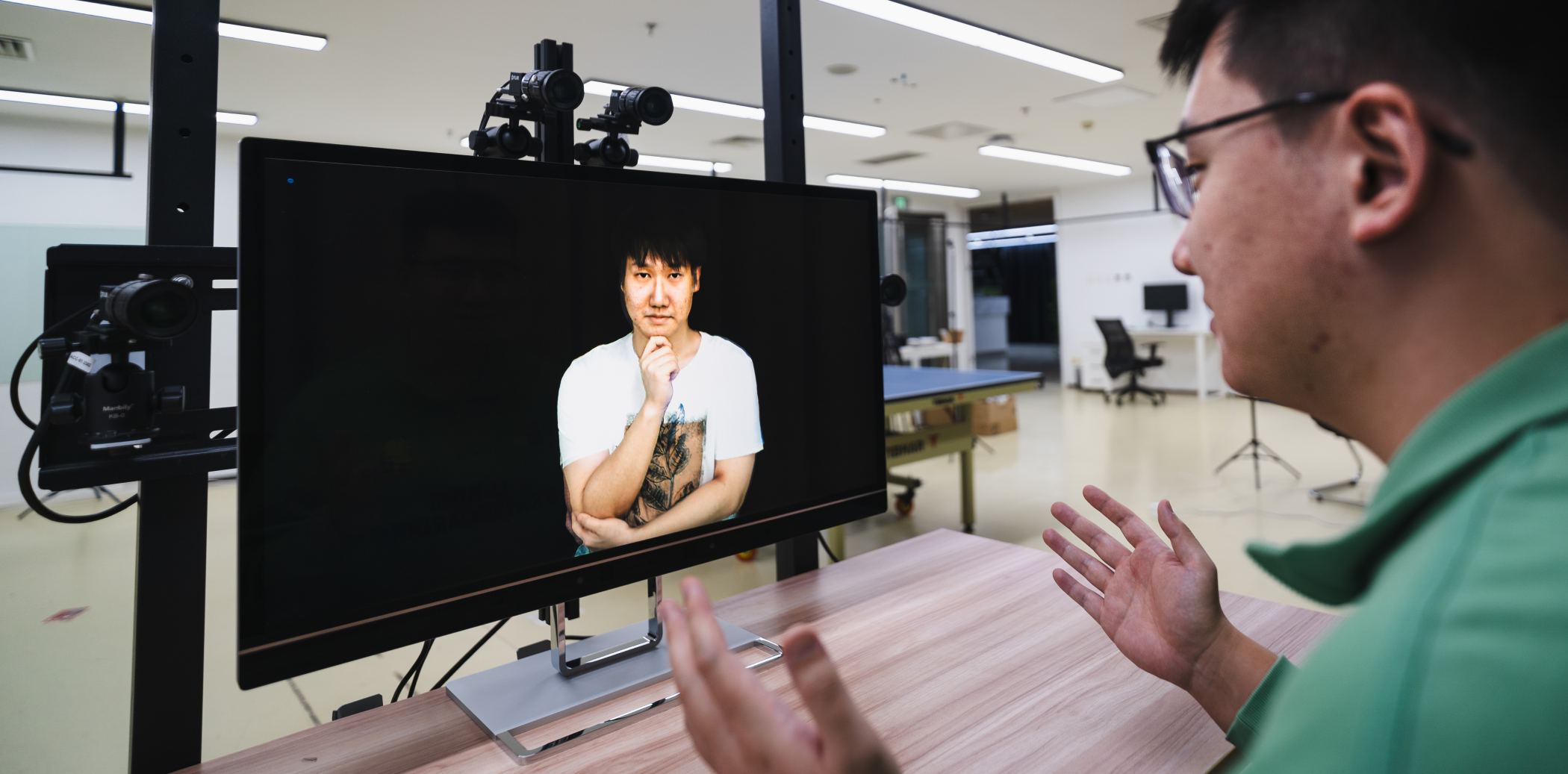
Tele-Aloha: A Low-budget and High-authenticity Telepresence System Using Sparse RGB Cameras.
Full-size figureComparison with previous telepresence systems
Scroll horizontally to see all columns. Keyboard: focus the table and use the arrow keys.
| System | Input setting | Efficiency | Resolution | GPU equipment | Complexity |
|---|---|---|---|---|---|
| Holoportation | 8 RGBD | 34 fps | — | 10 Titan X | Medium (F.B.) |
| LookinGood | 1 RGBD | 34 fps | 512 × 1024 | 1 Titan V | High (U.B.) |
| Starline | 3 RGBD | 60 fps | 1600 × 1200 | 2 RTX 6000 + 2 Titan RTX | High (U.B.) |
| VirtualCube | 6 RGBD | 30 fps | 1280 × 960 | 2 RTX 3090 + 1 RTX 2080 | High (U.B.) |
| MetaStream | 4 RGBD | 30 fps | — | 4 Jetson Nano + 1 RTX 2080S | Medium (F.B.) |
| AI-mediated | 1 RGB | 24 fps | 512 × 512 | 1 RTX 6000 + 1 RTX 4090 | Low (Head) |
| Live4d | 20 RGB | 24 fps | — | 4 RTX 3090 + 1 RTX 4090 | Medium (F.B.) |
| Tele-Aloha (ours) | 4 RGB | 30 fps | 2048 × 2048 | 1 RTX 4090 | High (U.B.) |
F.B. = full body; U.B. = upper body; RGBD = color and depth. A dash denotes no directly comparable image resolution in the source table.
These systems use different hardware and capture settings. This is a comparison of published configurations, not a controlled benchmark on identical equipment.
Efficient novel view synthesis
A cascaded disparity estimator supplies geometry cues. Gaussian splatting projects latent features to the target view, and weighted blending refines the image. Reconstruction, streaming, and display form an end-to-end real-time pipeline.
Cascaded Disparity Estimation
The upper pair has a smaller baseline, which is more robust for stereo matching, while the lower pair has a larger field of view. Therefore, we propose to estimate the disparity of the upper pair first and adopt it as initialization to estimate the disparity of the lower pair with more stability.
Neural Rasterization via 3DGS
The image encoder predicts the Gaussian properties instantly. Then, the latent-based 3DGS is rendered as the latent map at the novel view, and the neural image decoder is utilized to recover RGB images.
Occlusion-aware Rendering Refinement
A lightweight refinement module is engaged to generate the final output in full resolution. To fully leverage the high-resolution input of the system, it takes the refined image feature and a high-resolution image blended from source views as input, to produce high-resolution images.
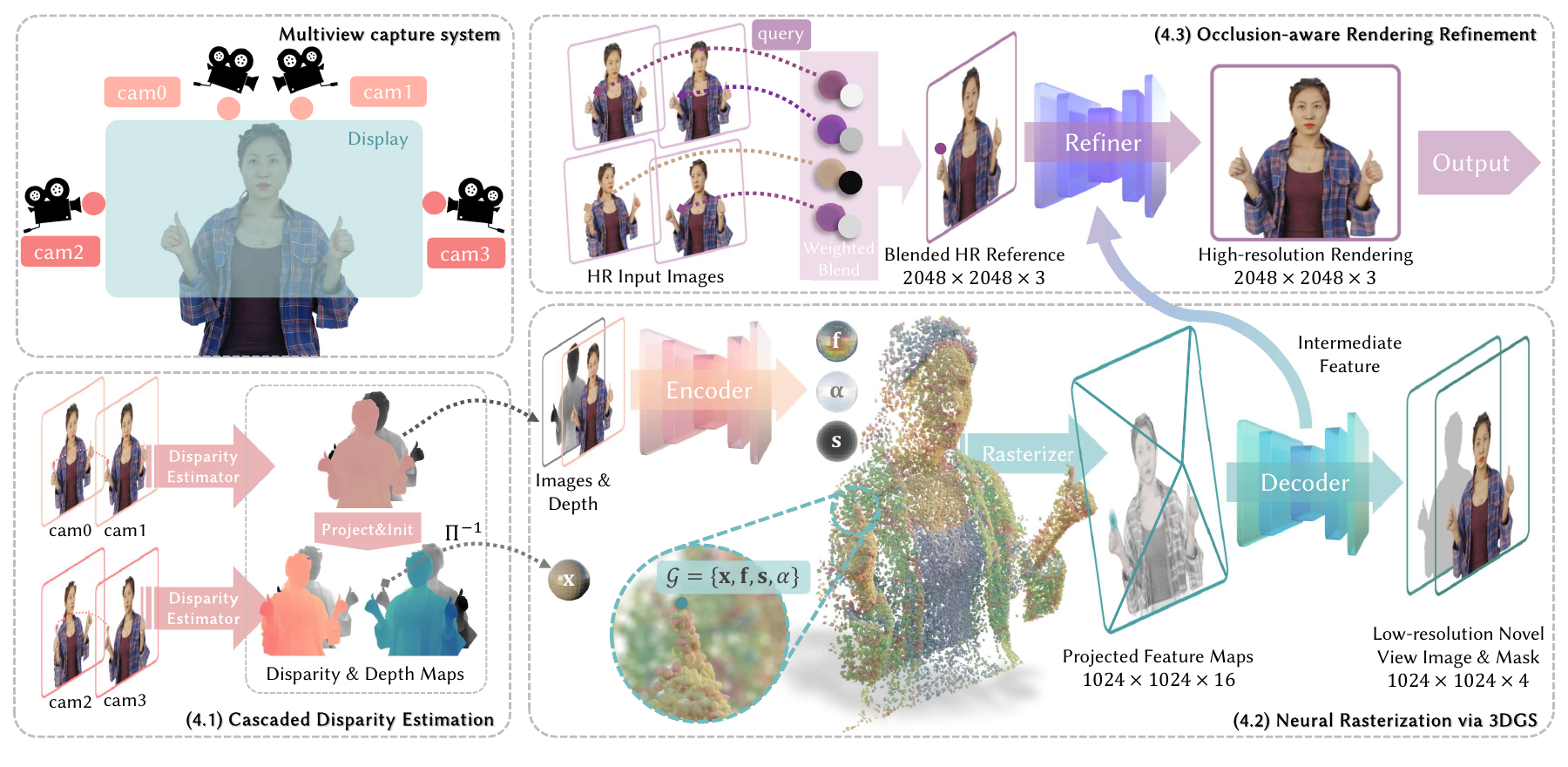
The pipeline of the proposed novel view synthesis algorithm. Given four input views that form two stereo pairs, we first estimate the disparity maps in the perspectives of these input views in a cascaded manner. Then, together with feature maps, scale maps, and opacity maps extracted by an image encoder, the pixels are lifted to 3D to form pixel-aligned 3DGS points. After that, feature vectors are rasterized to selected novel views, followed by a decoder that turns feature maps back into RGB images. Finally, a refiner module is applied to upsample the novel view rendering.
Full-size figureRealtime bidirectional communication
Blur and ghosting are due to monitor characteristics: the autostereoscopic display tracks only the eyes of the current user.
Video playback is unavailable here. Please try again later.
Static results on the THuman dataset
The proposed method is trained on THuman-Sit and THuman2.0. We split the THuman-Sit scans into two parts, 4000 for training and 700 for testing. We render source images parallel to our hardware setup and render novel views randomly among them.
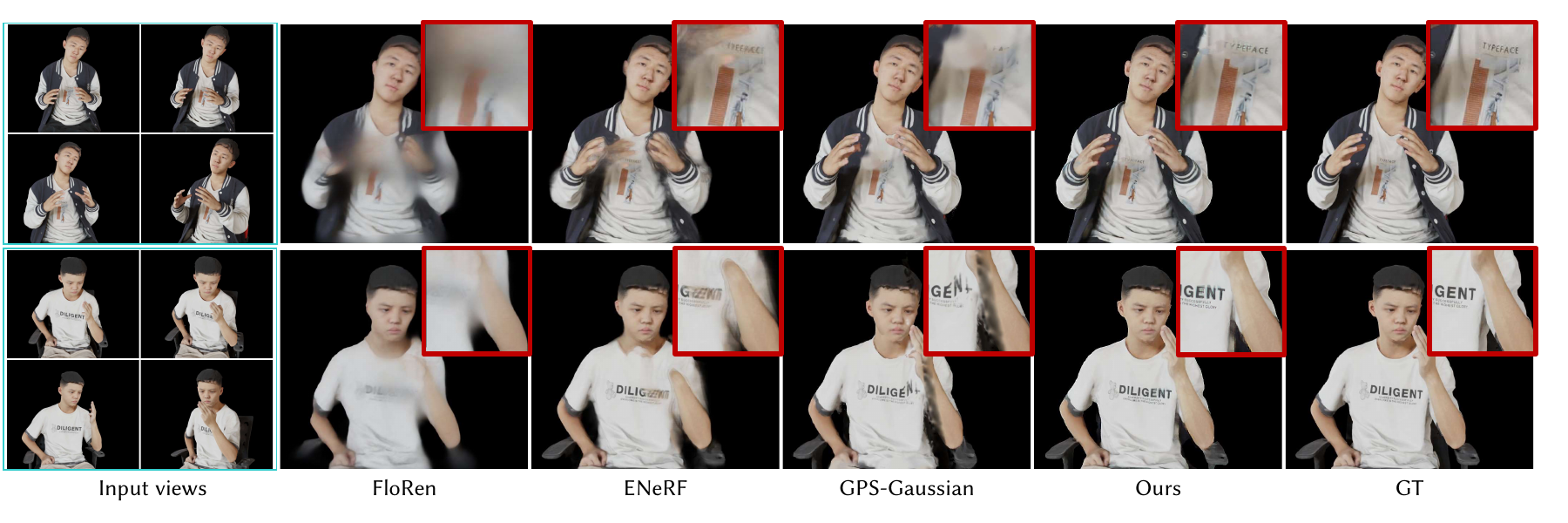
Comparison on sparse-view synthetic dataset against Floren, ENeRF, and GPS-gaussian.
Full-size figureDemo video
The original Tele-Aloha demonstration, hosted externally. Use the player controls to start playback.
Video playback is unavailable here. Please try again later.
Project scope
The cover illustrates remote communication. See the paper for system hardware, evaluation, and limitations.
Citation
@inproceedings{tu2024telealoha,
  title = {Tele-Aloha: A Low-budget and High-authenticity
           Telepresence System Using Sparse RGB Cameras},
  author = {Tu, Hanzhang and Shao, Ruizhi and Dong, Xue and
            Zheng, Shunyuan and Zhang, Hao and Chen, Lili and
            Wang, Meili and Li, Wenyu and Ma, Siyan and
            Zhang, Shengping and Zhou, Boyao and Liu, Yebin},
  booktitle = {ACM SIGGRAPH 2024 Conference Papers},
  year = {2024},
  doi = {10.1145/3641519.3657491}
}