GBC-Splat: Generalizable Gaussian-Based Clothed Human Digitalization under Sparse RGB Cameras
- 1 Tsinghua University
- 2 Harbin Institute of Technology
- 3 Lenovo Research
- Human reconstruction
- Gaussian splatting

TL;DR
GBC-Splat is a generalizable, feed-forward approach to clothed-human digitalization. It reconstructs human geometry and Gaussian appearance directly from sparse RGB input, without subject-specific optimization or an SMPL template.
Abstract
We present an efficient approach for generalizable clothed human digitalization, termed GBC-Splat. Unlike previous methods that necessitate per-subject optimizations or discount watertight geometry, the proposed method is dedicated to reconstructing complete human shapes and Gaussian Splatting via sparse view RGB inputs in a feed-forward manner.
We first extract a fine-grained mesh using a combination of implicit occupancy field regression and explicit disparity estimation between views. The reconstructed high-quality geometry allows us to easily anchor Gaussian primitives to mesh surface according to surface normal and texture, which allows 6-DoF photorealistic novel view synthesis. In addition, we introduce a simple yet effective algorithm to subdivide Gaussian primitives in high-frequency areas to further enhance the visual quality.
Without the assistance of human parametric models, our method can tackle loose garments, such as dresses and costumes. Our method outperforms state-of-the-art methods in terms of novel view synthesis while keeping high efficiency, enabling the potential of deployment in real-time applications.
- 8 RGB views
- Four stereo pairs in the main setting
- 6-DoF
- Free-viewpoint rendering
- 358 ms
- Full pipeline · RTX 4090
- Mesh + 2D GS
- Geometry-anchored appearance
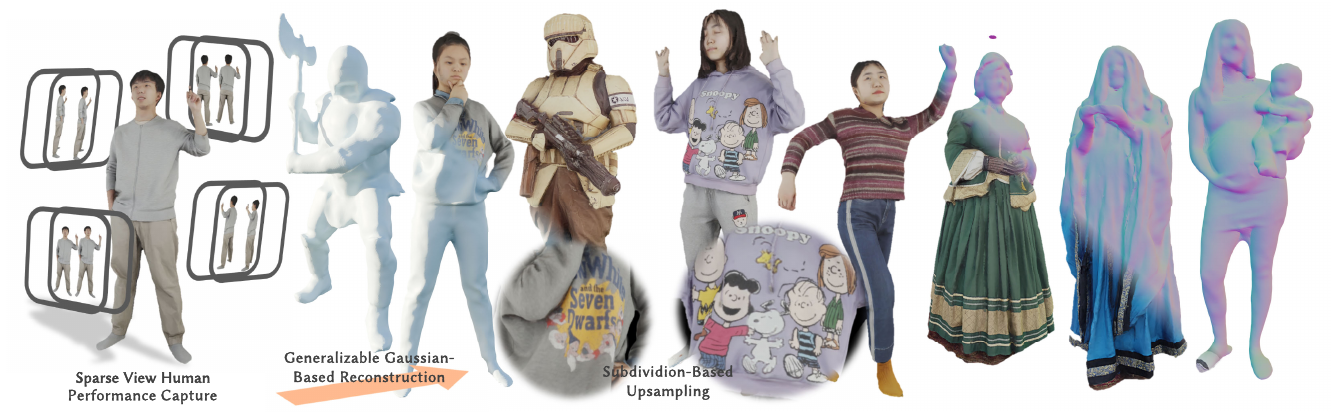
Human geometry reconstruction and rendering. We introduce a generalizable feed-forward Gaussian-based human digitalization pipeline. Based on high-quality geometry extraction, our pipeline lifts sparse RGB input images to Gaussian model in less than 0.3s.
Full-size figureQuantitative comparison of novel-view rendering
Scroll horizontally to see all columns. Keyboard: focus the table and use the arrow keys.
| Method | Input views | PSNR ↑ | SSIM ↑ | LPIPS ↓ |
|---|---|---|---|---|
| 2DGS | 8 | 25.81 | 0.8675 | 0.1719 |
| GPS-Gaussian | 6 | 20.39 | 0.8270 | 0.2490 |
| GPS-Gaussian | 8 | 24.68 | 0.8847 | 0.2008 |
| GHG | 4 | 17.85 | 0.7812 | 0.3333 |
| GHG | 8 | 17.88 | 0.7791 | 0.3381 |
| Ours | 8 | 24.94 | 0.8881 | 0.1269 |
| Ours (Subdiv.) | 8 | 25.86 | 0.8970 | 0.1188 |
THuman2.0 · ↑ Higher is better · ↓ Lower is better. Input-view counts follow the paper; Ours denotes GBC-Splat.
The 358 ms fact above is the sum of the full RTX 4090 pipeline in supplementary Table 5, including subdivision. Main-paper Table 1 reports an approximately 300 ms reconstruction setting; neither figure is a complete-system frame rate.
Method
Implicit occupancy regression and cross-view disparity estimation recover the surface. Gaussian primitives are anchored using surface normals and texture, with subdivision in high-frequency regions to refine appearance for 6-DoF novel-view synthesis.
Coarse-to-fine Mesh Extraction
In terms of geometry reconstruction, we apply a coarse-to-fine strategy to balance the performance and the efficiency. We design a neural implicit occupancy regression module with aggregation of cross-view 2D pixel-aligned features and 3D sparse features.
Mesh-anchored Gaussian Primitives
Each Gaussian surfel center is located at the vertex of the mesh and the orientation of each surfel can be determined by the normal direction of the mesh surface.
Gaussian Upsampling via Subdivision
Therefore, we design a texel-based subdivision algorithm to upsample Gaussian points on the Gaussian surfels with a minimum cost. Benefiting from the high-frequency texture of input views, such a subdivision algorithm is able to extremely increase rendering quality without any learning process.
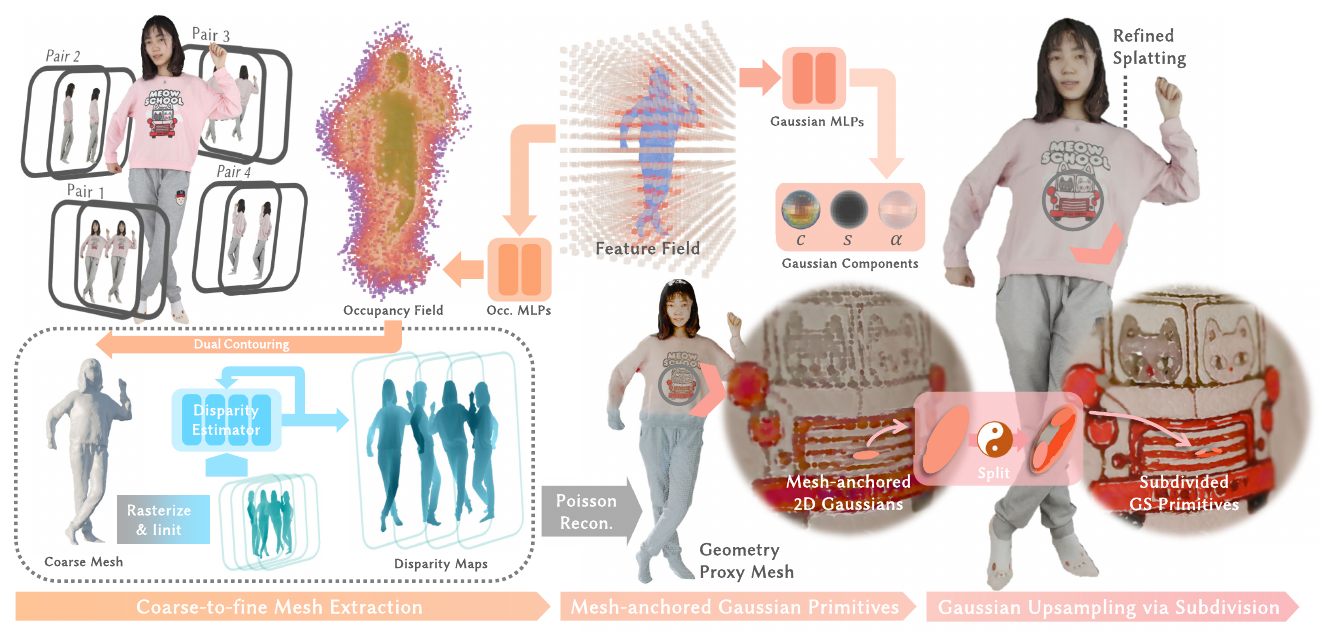
Figure 2. The pipeline of the GBC-Splat rendering and reconstruction. We extract a fine-grained mesh using a combination of implicit occupancy field regression and explicit disparity estimation between views. Further, we introduce a simple yet effective algorithm to subdivide Gaussian primitives in high-frequency areas to enhance the visual quality.
Full-size figureQualitative comparisons
In Tab. 2, our uniformly anchored Gaussian surfels have a competitive result for PSNR and SSIM, even compared to longtime optimized 2DGS, however with an outstanding LPIPS value which focuses on texture-level perceptive capability. In addition, our subdivision strategy adds more high-frequency details from input views and maintains global integrity, which further improves all metrics. Fig. 5 shows that our results preserve human integrity and avoid floating noises, compared to others.
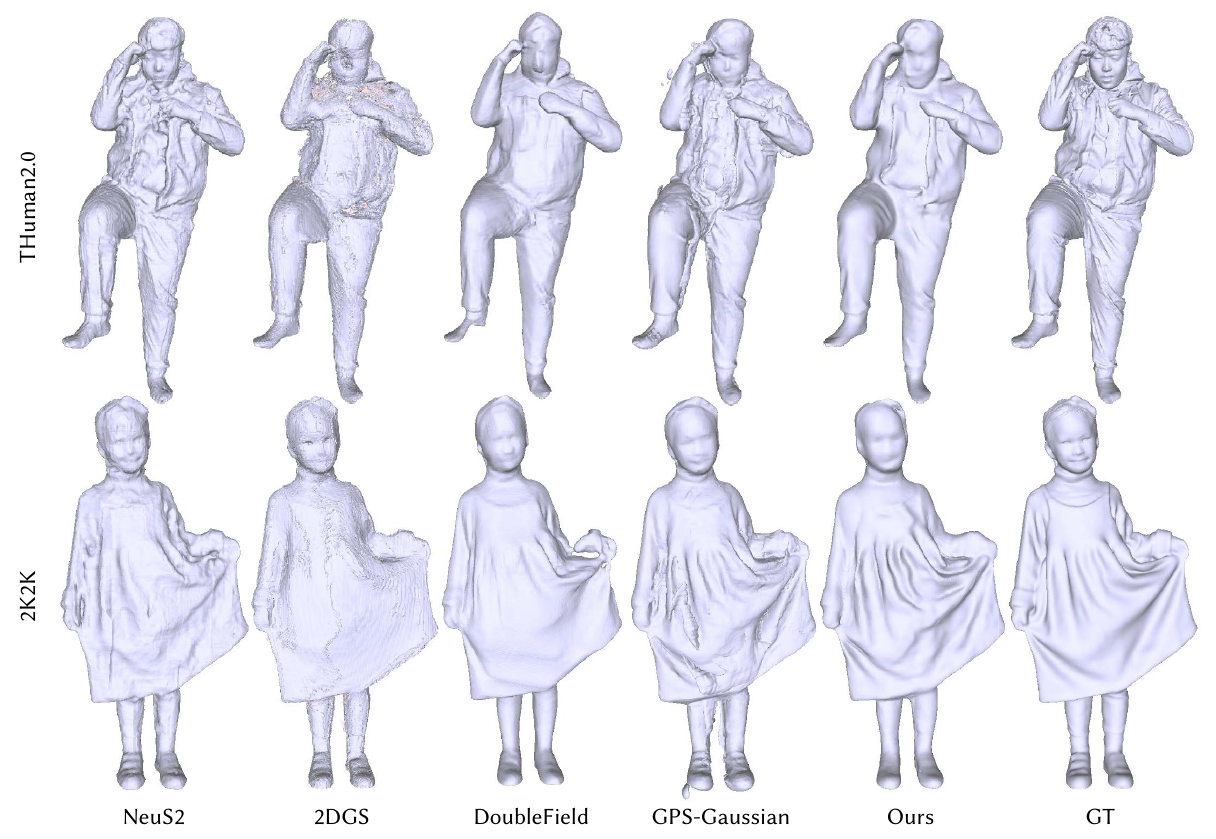
Figure 4. Qualitative comparisons on geometry reconstruction in THuman2.0 and 2K2K. From left to right: NeuS2, 2DGS, DoubleField, GPS-Gaussian, and Ours. All methods use 8 input views. The mesh acts as a geometry proxy for Gaussians, which are sensitive to floating artifacts and noises generated by other methods. The high-quality geometry enables the generalizable Gaussians anchoring and subdivision process.
Full-size figure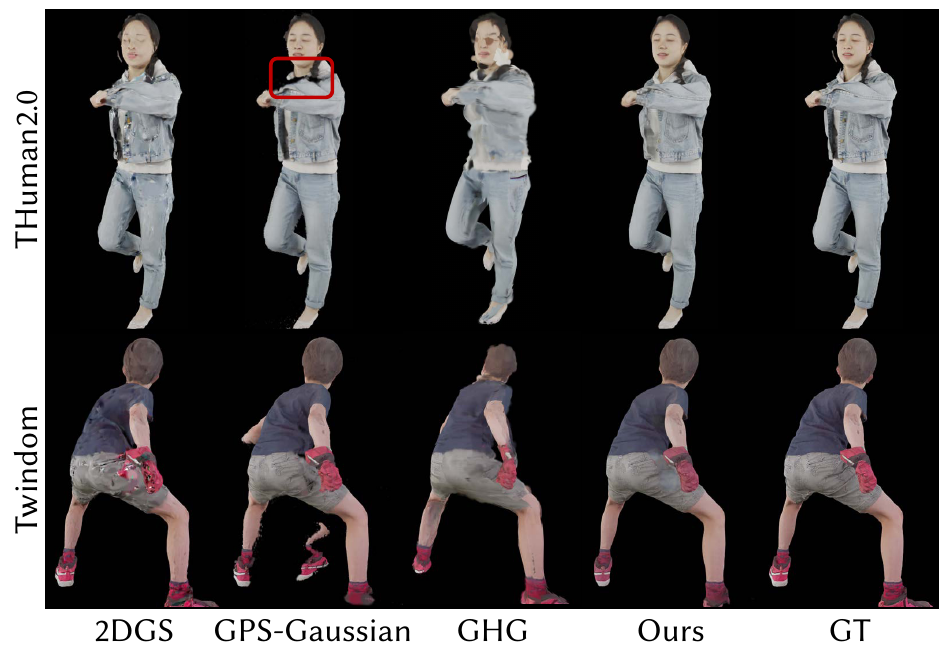
Figure 5. Qualitative comparisons on rendering in THuman2.0 and Twindom. From left to right: 2DGS, GPS-Gaussian, GHG, ours and ground truth. All methods use 8 input views.
Full-size figureDemo video
GBC-Splat demonstration.
Video playback is unavailable here. Please try again later.
Project scope
The cover illustrates sparse-camera human reconstruction. Research details and evaluation are available in the paper.
Citation
@inproceedings{Tu_2025_CVPR,
  author = {Tu, Hanzhang and Liao, Zhanfeng and Zhou, Boyao and
            Zheng, Shunyuan and Zhou, Xilong and Zhang, Liuxin and
            Wang, QianYing and Liu, Yebin},
  title = {GBC-Splat: Generalizable Gaussian-Based Clothed Human
           Digitalization under Sparse RGB Cameras},
  booktitle = {Proceedings of the IEEE/CVF Conference on
               Computer Vision and Pattern Recognition (CVPR)},
  month = {June},
  year = {2025},
  pages = {26377--26387}
}